Emergency microgrid deployment: A practical guide to planning and implementation
Key Takeaways
Emergency microgrid deployment works best when it begins with clear service priorities and realistic operating targets. Site conditions, approvals, safe installation, and tested procedures all shape whether a system can provide useful power during an outage.
- Identify the facilities and electrical loads that must remain available.
- Set outage-duration and capacity targets before selecting equipment.
- Match generation, storage, controls, and distribution to site conditions.
- Coordinate utility, authority, vendor, and crew decisions early.
- Test operating procedures and plan for maintenance and grid restoration.
Define the emergency power need
A deployment plan should begin with the services power is meant to protect, not with a preferred generator or battery. Hospitals, water systems, communications, shelters, and other facilities may have different priorities and acceptable interruptions. A clear definition of need gives engineers and decision-makers a basis for sizing, sequencing, and procurement. It also helps distinguish essential emergency service from normal operations.
Identify critical facilities and loads
Start by identifying which buildings, processes, and services must stay available during an outage. Within each facility, separate loads that are life-safety critical from those that support continuity or can be deferred, then confirm requirements with the people responsible for operating them. Emergency power microgrids can disconnect from the main grid and combine local generation, batteries, and controls to keep critical facilities running; the system boundary and the loads it serves still need to be defined for each site.
A useful load inventory records equipment, operating schedules, starting requirements, and the consequences of interruption. Include support systems that are easy to overlook, such as controls, communications, ventilation, and fuel handling. This early accounting is a practical way to avoid designing for a nameplate total that does not reflect real operating priorities.
Set outage-duration and capacity targets
Capacity and duration are related, but they answer different questions. Capacity describes how much power can be supplied at a given moment; duration describes how long the system can support a selected set of loads under stated conditions. Set targets using credible outage scenarios, load profiles, available fuel or stored energy, and the time needed to restore utility service.
A planning table can keep these assumptions visible while options are compared. Values should be filled in with site data rather than treated as generic design standards.
| Planning case | Loads served | Duration assumption | Design question |
|---|---|---|---|
| Short interruption | Essential controls and safety loads | Brief outage | What must transfer without a service gap? |
| Extended outage | Critical facility operations | Multi-hour or longer event | How will energy supply be replenished? |
| Constrained supply | Highest-priority loads only | Uncertain restoration time | Which loads can be shed first? |
Review the assumptions with facility operators and engineering staff. If the outage duration is uncertain, document the operating choices that preserve the most important services rather than implying that one capacity figure guarantees continuous operation.
Choose between temporary, permanent, and hybrid solutions
Temporary systems may suit urgent needs when permanent construction cannot be completed in time, but they still require safe connections, an appropriate location, and a defined operating plan. Permanent systems can be designed around the site’s electrical infrastructure and normal operating needs, though permitting and construction may take longer. A hybrid approach may combine existing equipment with temporary generation or storage, provided compatibility and protection are confirmed.
The choice depends on the emergency timeline, the expected useful life of the equipment, site access, and the level of engineering and approval work that can be completed. Consider feasibility early; a microgrid feasibility study can examine site data, technical viability, costs, regulatory hurdles, and implementation risks before investment decisions are fixed.
Assess the site and existing infrastructure
A system that fits a load calculation may still fail to fit the property. Site assessment connects the electrical design to utility service, equipment placement, fuel or renewable resources, access routes, and hazards. It should include a walkdown with facility staff and qualified electrical professionals. The result is a realistic basis for design, logistics, and schedule.
Review utility connections and electrical systems
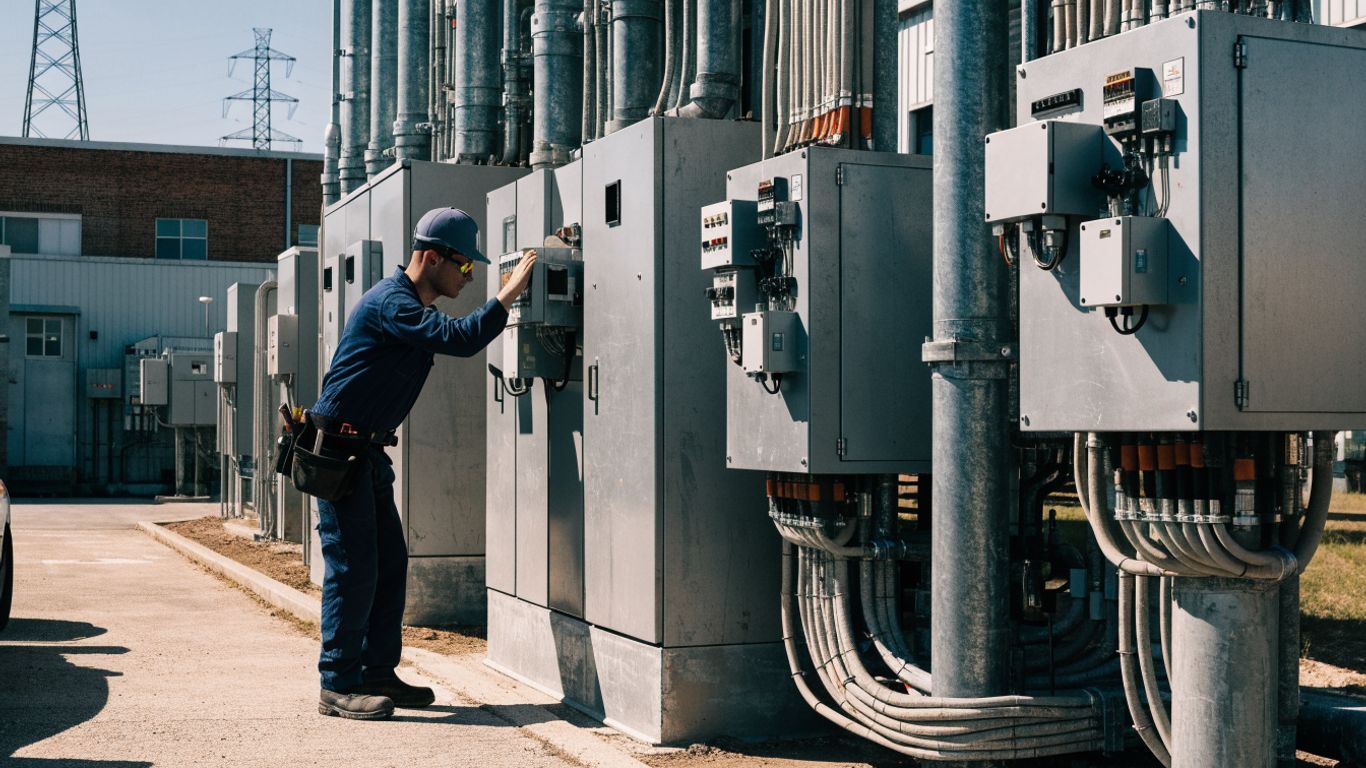
Document the point of connection, service voltage, protective devices, switchgear, grounding, and the condition of existing distribution equipment. Engineers need to understand how the facility is normally supplied and how the emergency system will be isolated or connected without creating unsafe backfeed. Drawings should be checked against field conditions, since older or modified installations may not match available records.
Also identify which panels or circuits serve the prioritized loads, and whether the existing distribution can support a separate emergency bus or other planned arrangement. A commercial interconnection study can help frame utility rules, operating modes, export plans, protection, and approval needs for a commercial building.
Evaluate fuel, solar, storage, and equipment access
Assess the practical supply chain for every proposed energy source. For fuel-based generation, consider delivery routes, onsite storage, replenishment access, and operating constraints. For solar and batteries, review available area, shading, equipment placement, electrical integration, and access for installation and maintenance. None of these options should be assumed available at the required scale until site conditions and equipment requirements are checked.
Delivery logistics matter as much as equipment selection during an emergency. Check whether trucks, cranes, and crews can reach the intended work areas, and identify staging areas that will not block facility operations. These details can expose conflicts while there is still time to adjust the layout.
Account for hazards, weather, and site constraints
Flooding, wildfire exposure, extreme heat or cold, wind, dust, and seismic conditions can affect equipment location and operation. Review the site’s known hazards and the design requirements applicable to the project; do not rely on generic assumptions about enclosures or clearances. Noise, emissions, drainage, security, and proximity to occupied areas may also affect placement and approvals.
The assessment should leave a record of constraints, assumptions, and unresolved questions. That record helps the design team decide what needs further engineering review and gives procurement teams a basis for evaluating equipment suitability.
Design a resilient microgrid
The design has to join sources, storage, controls, and electrical distribution into an operating system. Each component should be selected against the load priorities and outage scenarios established earlier. Engineering choices also depend on the utility interface and the conditions found during the site assessment. A microgrid is only as useful in an emergency as its ability to operate safely under the conditions it was designed to handle.
Select generation and battery technologies
Compare technologies by their ability to meet the site’s power and energy requirements, operating constraints, availability, and maintenance needs. Generators can provide dispatchable supply when fuel is available; solar output varies with conditions, and batteries store energy but require a charging source and controls. A combination may fit some sites, but the balance should follow a load study and operating scenarios rather than an assumption that one technology is always preferable.
Account for starting loads, continuous demand, charging requirements, and the period each resource is expected to support operations. The design should also make clear what happens if a source is unavailable or fuel delivery is delayed. These limitations are part of the capacity decision, not afterthoughts.
Plan controls, islanding, and load prioritization
Controls govern how the microgrid changes between grid-connected and islanded operation, how sources coordinate, and how operators respond when supply is limited. The design should specify the isolation point, synchronization approach where applicable, monitoring needs, and a prioritized sequence for shedding and restoring loads. The operating sequence should be understandable to the staff who will use it under pressure.
A concise priority sequence can make those decisions easier to review before commissioning:
- Maintain life-safety and protection systems.
- Preserve essential communications and control functions.
- Supply critical process or facility loads within available capacity.
- Shed deferrable loads when generation or stored energy is constrained.
Operators and engineers should validate the sequence against actual facility operations. A written priority list does not replace control testing, but it gives the team a shared basis for deciding what the system should do when conditions change.
Build in redundancy and future expansion
Redundancy should address credible failure points, such as a source, control component, or distribution path that could interrupt critical service. The right approach depends on the consequences of failure, equipment availability, and how much complexity operators can support. Additional equipment can increase cost and maintenance needs, so resilience goals should be explicit rather than expressed as “more backup” without a defined purpose.
Where future expansion is likely, reserve physical space and consider how additional loads or sources could be integrated. The design should document interfaces and assumptions so later changes can be evaluated without compromising protection or safe operation.
Navigate procurement and approvals
Emergency schedules can compress decision-making, but they do not remove the need for coordination. Utility review, authority approvals, equipment availability, and installation requirements can all affect the critical path. Treat these items as design inputs, not paperwork to be handled after equipment arrives. A clear procurement package helps vendors and reviewers respond to the same scope.

Coordinate with utilities and local authorities
Contact the utility and relevant local authorities early to identify applicable procedures, review timelines, required drawings, and any restrictions on operating modes. Clarify how the system will interact with the grid, including isolation and any planned parallel operation or export. Requirements vary by location and project, so confirm them directly rather than relying on another site’s process.
Early coordination can also reveal technical or procedural issues that would otherwise surface late in the schedule. Keep a record of decisions, submissions, responsible contacts, and open items so the project team can track what remains unresolved.
Compare equipment availability and vendor capabilities
Compare vendors against a defined technical scope, delivery window, installation requirements, and service expectations. Confirm what equipment is actually available, what substitutions may be offered, and which interfaces or accessories are included. A proposal should be evaluated for fit with the project—not only by the headline rating or delivery promise.
Ask vendors to identify assumptions, exclusions, and commissioning responsibilities. For community projects, reports of permitting delays and interconnection challenges underline why schedule and approval dependencies deserve attention alongside equipment lead times.
Address permits, interconnection, and safety requirements
The project team should identify permits, inspections, interconnection steps, and applicable electrical and fire-safety requirements for the specific jurisdiction and equipment. Qualified professionals should review protection, grounding, clearances, fuel systems, switching, and safe work procedures. Emergency conditions may change the schedule, but they do not make unsafe connections acceptable.
Maintain a compliance and approval tracker with owners and due dates. If an emergency installation is temporary, clarify which requirements still apply and what approvals are needed before energization; do not assume that temporary status removes those obligations.
Deploy the system under emergency conditions
Deployment under pressure calls for disciplined sequencing. The project lead should align the work plan with the site’s operating needs, equipment delivery, utility coordination, and safety controls. A short schedule is useful only if it reflects realistic access and installation dependencies. Work should stop when site conditions or scope changes make the approved plan unsafe or incomplete.
Sequence site preparation and equipment delivery
Prepare the site before delivery where possible: verify the layout, access, foundations or supports, cable routes, work boundaries, and required clearances. Confirm that the receiving area and lifting plan suit the actual equipment dimensions and weights. Coordinate deliveries so temporary storage does not obstruct emergency services or normal facility operations.
Sequence work around dependencies such as isolation, equipment placement, distribution connections, inspections, and testing. If a delivery slips or an area becomes inaccessible, use a documented contingency plan rather than improvising a new route or connection in the field.
Install generation, storage, and distribution components
Installation should follow approved drawings and manufacturer requirements, with qualified personnel responsible for electrical, fuel, and lifting work. Verify equipment identification, connections, protection, grounding, and cable routing before energization. Keep generation, storage, and distribution work coordinated so that interfaces are checked as a system, not treated as separate tasks.
Field conditions can differ from plans, particularly during emergency response. Record approved changes and have the responsible engineering and safety staff review any change that affects equipment ratings, protection, access, or operating sequence.
Coordinate crews, communications, and contingency plans
Assign a site lead, define who can authorize switching, and establish a clear method for communicating status and hazards across crews. Brief contractors on work boundaries, isolation points, emergency contacts, and stop-work conditions. These practices reduce confusion when several teams are working around energized or soon-to-be-energized equipment.
Keep contingencies practical and specific: identify alternate staging or access arrangements, escalation contacts, and the steps to pause work if equipment or approvals are delayed. A brief, shared plan is more useful than a long document that crews cannot find or interpret during deployment.
Commission and sustain operations
Commissioning demonstrates whether the installed system behaves as intended; it is not simply a final equipment startup. Testing should follow an approved plan, account for the facility’s operational risks, and include the people who will run the system. The project should not be considered ready for emergency service until required checks, training, and documentation are complete.
Test islanding, synchronization, and load shedding
Develop test procedures for the intended operating modes, including safe separation from the utility, source coordination, and the planned sequence for shedding or restoring loads. Tests should confirm that protective functions and controls respond as designed, and that operators can recognize abnormal conditions. The precise test scope depends on the system and applicable requirements.
Document results, deficiencies, corrective actions, and retest outcomes. Where a full-scale test would put operations at risk, engineers should determine a safe and technically appropriate method to validate the relevant functions.
Train operators and document emergency procedures
Train operators on normal and emergency modes, alarms, load priorities, switching authority, and safe shutdown. Procedures should state who makes decisions, how to contact technical support, and what conditions require isolation or escalation. Practice helps reveal unclear instructions before an actual outage creates time pressure.
Keep current one-line diagrams, equipment manuals, test records, contact lists, and operating procedures accessible to authorized staff. Update them when system configuration or personnel responsibilities change.
Monitor performance, maintain equipment, and plan restoration
A sustaining plan should assign responsibility for inspections, maintenance, fuel and consumables, battery condition monitoring, and corrective work. Monitoring helps staff identify changing conditions, but alarms and data only help when someone is assigned to review them and act. Set maintenance intervals and operating checks according to equipment documentation and the project’s requirements.
Plan restoration as part of emergency operations. Define how the system will return to grid-connected operation, who will authorize switching, and how loads will be stabilized during the transition. After each test or outage, review what worked, what did not, and whether operating assumptions need to change.
Conclusion
Emergency microgrid deployment is a coordinated engineering and operations effort, shaped by the loads that matter, the site that must support them, and the approvals and logistics needed to install safely. Clear targets, an integrated design, and realistic commissioning and maintenance plans give teams a stronger basis for keeping essential services available when grid power is interrupted.
Frequently Asked Questions
What is an emergency microgrid?
An emergency microgrid is a local power system designed to serve selected loads when normal utility service is interrupted. Depending on its design, it may operate connected to the grid or independently from it.
Which facilities should receive emergency microgrid power?
Prioritize facilities and services according to the consequences of losing power, such as life safety, essential communications, water, healthcare, or critical operations. The appropriate priorities depend on local needs and facility responsibilities.
How is microgrid capacity determined?
Capacity is determined by studying the loads the system must serve, including operating patterns and equipment starting requirements. Engineers also assess how those loads change across normal and emergency operating modes.
How long can an emergency microgrid operate?
Operating duration depends on the energy sources, stored energy, fuel or other replenishment arrangements, and the loads being served. A plan should state its assumptions and explain how service will be adjusted if an outage lasts longer than expected.
Can a microgrid use both solar and generators?
A system can be designed with multiple sources, including solar, storage, and generators, if the components and controls are compatible and the design meets site requirements. The appropriate combination depends on load, available resources, operating goals, and constraints.
What approvals may be needed before installation?
Requirements vary by jurisdiction and project. They may involve utility coordination, interconnection review, permits, inspections, and electrical or fire-safety requirements, so the project team should confirm them with the relevant authorities.
What should be tested before an emergency microgrid is relied upon?
Testing should verify the intended operating modes, safe isolation, source coordination, protective functions, controls, and load prioritization. Operators should also be trained, and deficiencies should be corrected and documented before the system is treated as ready for service.