
Hospital Microgrid Design for Continuous Critical Power
Key Takeaways
Hospital microgrid design begins with clinical priorities, not equipment lists. A reliable plan connects load classification, resilient architecture, carefully coordinated controls, compliance, and tested operations.
- Classify loads by patient risk, operational importance, and restoration priority.
- Design redundant generation, distribution, transfer, and communications paths.
- Pair generation and storage with realistic fuel and outage assumptions.
- Test islanding, black start, protection, power quality, and manual procedures.
- Measure reliability, cost, emissions, fuel use, and maintenance over time.
Define hospital power requirements and resilience goals
A hospital cannot treat every electrical load as equally urgent. The design team must translate clinical services into power priorities, then set resilience objectives that facilities staff can operate and verify. That work creates the foundation for every later decision about generation, storage, feeders, and controls.
Classify critical, essential, and nonessential loads
Start with an updated load inventory rather than relying on old panel schedules. Life-safety systems, operating rooms, intensive care, medical gases, communications, refrigeration, elevators, ventilation, and information systems may have different restoration requirements even when all are considered important. Grouping them into critical, essential, and nonessential categories gives the controller a practical basis for staged restoration.
Record normal demand, starting current, power factor, harmonic behavior, and acceptable interruption time for each major load. Some equipment needs nearly instantaneous support, while other equipment can tolerate a short transfer or delayed restart. The classification should be reviewed with clinical engineering, nursing leadership, infection prevention, and facilities operations.
Map clinical dependencies and failure consequences
A load may appear noncritical until its dependencies are traced. A surgical suite, for example, relies not only on lighting and receptacles but also on air handling, controls, communications, medical gas monitoring, and access systems. Mapping these relationships reveals the consequences of losing a feeder, a cooling system, or a communications network rather than considering each circuit in isolation.
Use scenario workshops to ask what happens after a brief voltage sag, a prolonged outage, a failed generator, or the loss of one electrical room. Document patient-safety consequences, required staffing changes, and the time available to intervene. This approach keeps the design connected to care delivery instead of treating resilience as a purely electrical target.
Set uptime, islanding, and black-start objectives
Define how the campus should behave before selecting equipment. Objectives may include automatic separation from the utility, uninterrupted service to selected branches, operation for a specified duration, black start without utility power, and orderly resynchronization after the grid stabilizes. Each objective needs an acceptance test and an owner.
Black start also requires a sequence: energize a source, establish a stable bus, connect selected transformers, and restore loads without excessive inrush. A useful black-start planning guide can help teams frame that sequence, but hospital-specific protection studies and commissioning procedures remain essential. The goal is not simply to own backup assets; it is to prove that the campus can recover in a controlled order.
Account for growth, electrification, and emergency scenarios
A hospital that adds imaging equipment, electric heating, kitchen capacity, electric vehicles, or new clinical buildings can outgrow a system sized only for today’s peak. Model expected demand by hour and season, then include motor starts, future construction, and temporary emergency loads. Weather, fuel interruptions, utility constraints, and evacuation or surge-care scenarios should be part of the same analysis.
A practical model compares normal operation, utility outage, equipment failure, fuel restriction, and unusually high demand. It should also show which flexible loads can be reduced without compromising care. Those results become design inputs for generation capacity, battery duration, feeder ratings, and operating procedures.
Build the hospital microgrid architecture
Architecture determines whether resilience is real or merely duplicated nameplate capacity. The system must define electrical boundaries, sources, feeders, transfer points, protection zones, and the conditions for connecting or separating from the utility. A well-planned arrangement also leaves room for maintenance and construction without taking essential services offline.
Coordinate utility service, feeders, and transfer equipment
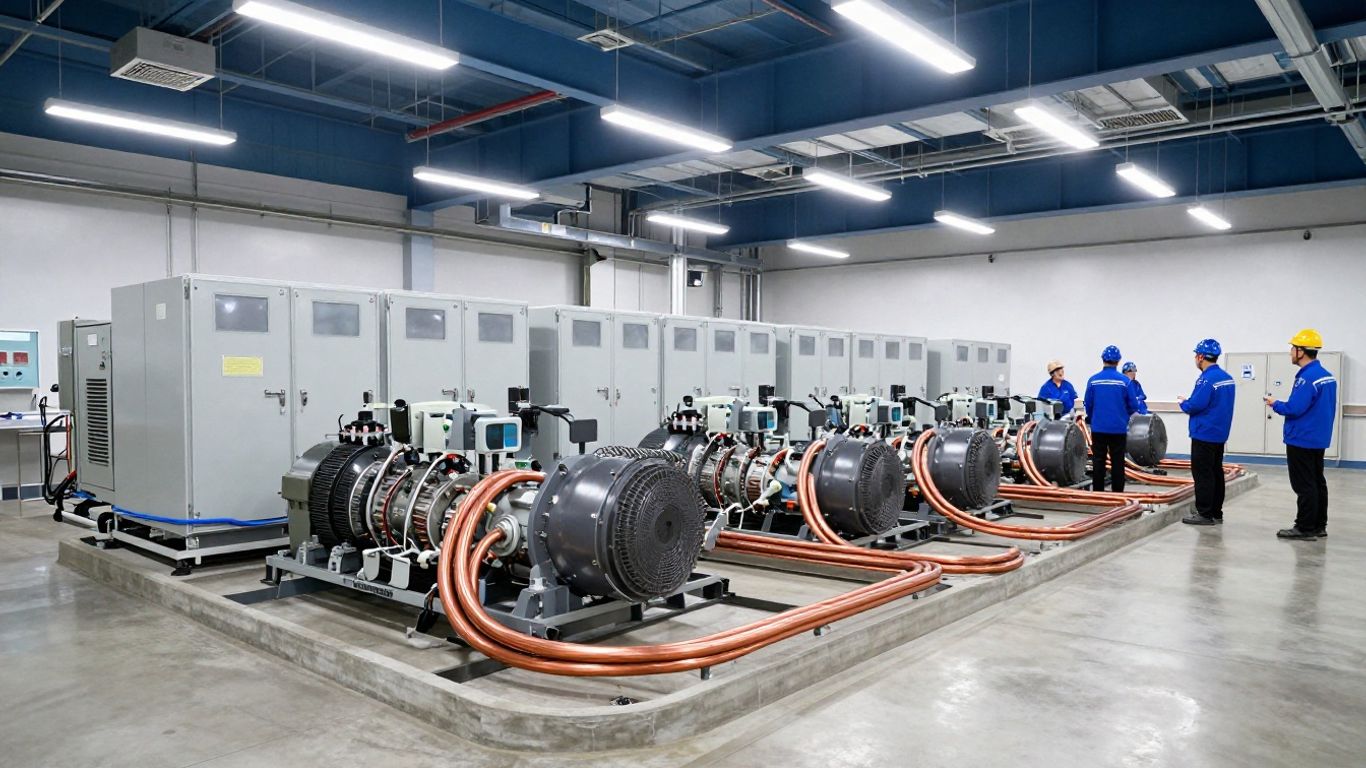
Begin at the point of common coupling and trace power through service entrances, switchgear, transformers, emergency branches, and downstream panels. Utility interconnection requirements, fault current, grounding, metering, and available short-circuit duty must be addressed early. Transfer equipment should be selected and located so that normal and emergency sources can be isolated, tested, and maintained safely.
The design should show what happens when a utility source is lost or a feeder faults. Automatic transfer switches, bypass-isolation arrangements, and selective coordination must work together rather than being specified as unrelated packages. A broader microgrid architecture guide offers useful framing for interconnection, feeders, controls, and expansion planning.
Design redundant generation and distribution paths
Redundancy is more than installing two generators in the same room. Review fuel trains, cooling, exhaust, switchgear sections, transformers, cables, communications, and control power for shared failure points. Where practical, distribute sources and routes so that fire, flooding, maintenance, or a single fault does not remove every path to a clinical area.
Ring or sectionalized distribution can provide alternatives to a simple radial arrangement, but it also introduces protection and switching complexity. The right topology depends on the campus, load density, available space, and operating skill. Perform contingency studies for the loss of each major source, feeder, transformer, and controller communication path.
Separate life-safety loads from operational and flexible loads
Separate branches make priority decisions visible and protect life-safety circuits from inappropriate shedding. Operational loads may include diagnostic services, pharmacy systems, kitchens, and administrative functions, while flexible loads can include selected ventilation, charging, thermal storage, or other systems that can be shifted temporarily. The boundaries should be documented in drawings and in the controller’s operating logic.
Physical separation is valuable, but it does not replace a load-management plan. A flexible load can become clinically important during a heat wave, infectious-disease response, or high-occupancy event. Review priorities with the people who run each service, and update them when clinical operations change.
Plan points of common coupling and intentional islanding
The point of common coupling must support safe disconnection, stable island operation, and controlled reconnection. Engineers should define voltage and frequency limits, anti-islanding behavior, synchronization checks, fault isolation, and the sequence for returning to utility service. If an emergency branch is intended to island separately, its electrical boundary and source capacity need especially careful study.
Islanded operation should be modeled with the same loads and contingencies used for normal planning. Do not assume that a source capable of carrying the average load can manage motor starts, changing clinical demand, or a sudden renewable-energy reduction. The design should state which loads remain online, which are delayed, and which are shed first.
Integrate existing hospital infrastructure without disrupting care
Most hospital projects are retrofits carried out beside occupied clinical spaces. Survey existing switchgear, raceways, grounding, emergency branches, generator controls, and undocumented modifications before finalizing the design. Temporary power, infection-control barriers, shutdown windows, and a clear escalation plan are as important as the permanent equipment.
Sequence work so that one source or distribution path remains available while another is modified. Use factory testing and off-site panel assembly where appropriate, and coordinate every planned interruption with clinical leaders. A phased approach reduces the chance that construction itself creates the outage the project is meant to prevent.
Select generation and energy storage technologies
Technology selection should follow the resilience objectives and the hospital’s physical setting. Sources differ in fuel dependence, start time, emissions, maintenance, noise, heat output, and performance during an extended outage. Storage can bridge transitions and shape demand, but it must be sized for the operating mode rather than treated as a generic backup box.
Compare natural gas generators, renewables, and combined heat and power
Natural gas generation can provide firm capacity, but pipeline pressure and regional supply interruptions deserve the same scrutiny as an electrical outage. Renewable generation can reduce daytime utility demand and emissions, yet its output varies with weather. Combined heat and power may add value where the hospital has a steady thermal demand and the site can safely use recovered heat.
Compare sources across normal operation and emergency operation. Ask whether each asset can start without the grid, support voltage and frequency, operate through a fuel disruption, and be maintained while another source carries the load. A mixed portfolio is useful only when the sources and controls have been engineered to work together.
Size battery energy storage for ride-through and peak support
Battery sizing begins with the loads that must remain online, the required ride-through time, inverter capability, reserve margin, and the duration of an expected transition. Separate power needs in kilowatts from energy needs in kilowatt-hours. A battery may be excellent for fast support and peak reduction without being intended to carry the entire hospital for many hours.
Include degradation, temperature, fire protection, replacement timing, and end-of-life capacity in the financial and technical model. Evaluate whether the battery is grid-forming or grid-following in the intended operating mode, and confirm how it coordinates with generators and transfer equipment. Its value is highest when its normal and emergency duties are clearly assigned.
Evaluate fuel availability, storage, and replenishment risks
Fuel planning should cover the complete outage, not just the first generator start. Confirm storage capacity, delivery access, vendor arrangements, testing requirements, fuel quality, and the possibility that roads or regional infrastructure will be unavailable. Natural gas, diesel, and other fuels each have different failure modes and replenishment assumptions.
Facilities teams should know how much reserve remains at each operating level and when a delivery must be requested. Include generator derating, winter conditions, heat, and competing demand from other emergency facilities. A source that cannot be refueled during a prolonged event is not equivalent to one with dependable replenishment.
Coordinate solar generation with hospital load profiles
Solar can align with daytime cooling, ventilation, and clinical demand, while batteries can shift some energy into later hours. Grid-tied solar alone generally cannot keep a facility energized during a utility outage unless the system has suitable isolation and control equipment. The solar outage guidance is written for smaller systems, but its central design question—what enables solar to operate safely during an outage—also matters in campus planning.
Model seasonal production against the hospital’s load curve and islanded operating limits. Confirm inverter behavior, fault contribution, voltage regulation, and curtailment requirements. Solar should be treated as one coordinated resource within the microgrid, not as an independent emergency source.
Plan backup technologies for extended outages
Extended events call for layers rather than a single optimistic assumption. Battery storage may cover short interruptions, generators may supply firm power, and solar or combined heat and power may reduce fuel consumption during longer operation. Mobile equipment, spare transformers, temporary fuel systems, and mutual-aid arrangements can add resilience when permanent capacity is unavailable.
Select the layers according to the hospital’s site risks and clinical mission. Rural access, wildfire smoke, flood exposure, and limited fuel deliveries may change the preferred mix. Every backup technology should have a defined connection method, protection scheme, maintenance plan, and trained operator.
Engineer controls for continuous critical power
Controls turn separate assets into an operating system. They must detect abnormal utility conditions, make decisions within required time limits, protect equipment, and communicate a clear state to operators. The best sequence is one that has been modeled, simulated, tested, and kept understandable enough for a facilities team to supervise.
Use microgrid controllers for automatic detection and dispatch
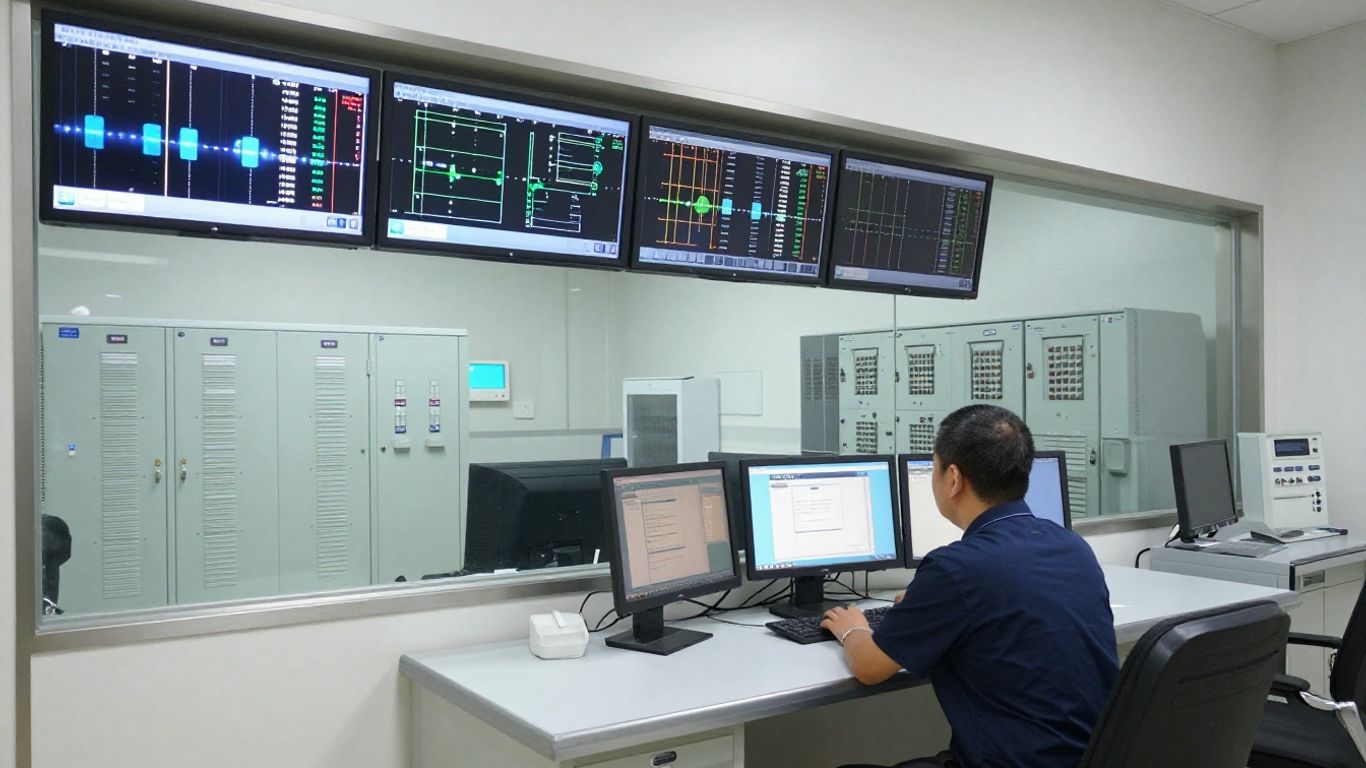
A microgrid controller can monitor utility status, source availability, bus conditions, load demand, and alarms, then coordinate dispatch according to approved priorities. Define the signals, decision authority, timing, and fallback behavior before writing control narratives. Communications loss should produce a known safe state rather than an ambiguous one.
Dispatch logic should account for generator minimum loading, battery state of charge, renewable variability, thermal demand, and reserve capacity. Controller selection should also consider interoperability, lifecycle support, cybersecurity, and manual operation. Automatic behavior is valuable only when operators can see why a decision was made.
Coordinate automatic transfer switches and protective relays
Automatic transfer switches and protective relays have different responsibilities, so their timing and settings must be studied together. Transfer should not defeat selective coordination, energize a faulted bus, or create an unsafe source connection. Protection studies should cover normal, generator, battery-supported, and islanded conditions.
Review relay logic after every major equipment change. Inverter-based resources can alter fault behavior, while generators can contribute different current levels depending on their operating state. Field verification should confirm that settings, wiring, communications, and breaker positions match the approved design.
Design black start, resynchronization, and staged load restoration
Black start begins with a dead or isolated system and restores it without relying on the utility. Establish the source and reference bus first, then energize transformers and feeders in an order that controls inrush and avoids overloading the available source. Resynchronization requires matching voltage, frequency, phase angle, and approved switching conditions.
Staged restoration is safer than reconnecting every load at once. A useful staged restoration resource describes the general sequence from isolation and bus energization to gradual load pickup. Hospital engineers must adapt that sequence to their own equipment, clinical priorities, protection settings, and emergency procedures.
Prioritize loads during constrained generation conditions
A constrained condition may follow the loss of a generator, a low battery state of charge, extreme heat, or a fuel limitation. The controller should use a documented hierarchy that protects life-safety functions first while preserving the services most needed for patient care. Shedding should be predictable, selective, and communicated to operators.
Consider rotating or delaying flexible loads rather than applying broad shutdowns. Cooling and ventilation require special treatment because reducing them can create new clinical and equipment risks. Test each priority transition with the departments affected, including the alarms and recovery steps staff will actually see.
Maintain safe manual overrides and operator visibility
Operators need local controls, clear one-line diagrams, alarm priorities, source status, breaker position, fuel status, and battery condition. Manual overrides should be deliberate and protected from accidental activation, but they must remain available when automatic controls or communications fail. Procedures should state who can authorize an override and how the resulting condition is recorded.
A control room display is not enough by itself. Provide local indication where needed, independent emergency communications, and routine exercises that require staff to interpret alarms. Human-readable procedures matter when a real event is noisy, stressful, and unfolding faster than a training scenario.
Meet safety, code, and healthcare compliance requirements
Compliance is part of the design basis, not a final paperwork step. Healthcare electrical systems combine public safety, patient vulnerability, specialized equipment, and complex emergency branches. The project team should involve the authority having jurisdiction, infection-control representatives, clinical engineering, electrical engineers, and the utility early.
Apply NFPA 99 and NFPA 110 requirements
NFPA 99 addresses healthcare facility risks and essential electrical system considerations, while NFPA 110 addresses emergency and standby power systems. The exact application depends on the facility, space classification, equipment, and adopted edition. Confirm requirements with the authority having jurisdiction and document how the microgrid interacts with the hospital’s existing emergency power branches.
Review source transfer, generator performance, testing, annunciation, separation, fuel systems, and maintenance obligations as one system. A microgrid does not erase requirements that apply to emergency power equipment. It must be integrated without compromising the established life-safety framework.
Coordinate NEC, IEEE, and local utility standards
The National Electrical Code, applicable IEEE practices, local amendments, and utility interconnection rules can impose overlapping requirements. Resolve conflicts through a coordinated design basis, equipment ratings, protection study, grounding plan, and interconnection review. Permitting and utility approval schedules should be reflected in the project plan from the beginning.
Standards also affect testing and documentation. Keep approved drawings, relay settings, control narratives, equipment certifications, and commissioning records in a controlled system. That record helps future staff understand why the system behaves as it does.
Protect patients and staff from arc-flash and electrical hazards
Arc-flash analysis should reflect every operating mode, including generator and islanded conditions. Use the results to define labels, boundaries, personal protective equipment, equipment settings, remote operation, and energized-work procedures. Physical access, fire separation, ventilation, battery safety, and emergency response deserve equal attention.
Hospital work also happens around patients, visitors, and contractors who may not understand electrical hazards. Secure rooms, control access, coordinate shutdowns, and communicate changes plainly. Safety measures should be designed into the project rather than added after installation.
Validate power quality for sensitive medical equipment
Medical equipment can respond badly to voltage sags, transients, frequency variation, harmonics, and poorly timed transfers. Establish acceptable power-quality limits with equipment manufacturers and clinical engineering, then test them at representative buses and under realistic source transitions. UPS systems, filters, inverters, generators, and transformers should be evaluated as an interacting chain.
Record baseline measurements before construction so that post-commissioning results can be compared. Investigate nuisance trips and unexplained resets rather than assuming sensitive equipment is defective. Power quality is a patient-care and operational concern, not just a waveform issue.
Address cybersecurity for controllers and connected devices
Microgrid controllers, relays, meters, gateways, and remote-access tools expand the hospital’s cyber exposure. Segment networks, restrict privileges, control vendor access, maintain secure backups, and document how patches are evaluated against uptime and safety requirements. Cybersecurity planning should include loss of communications and corrupted data, not only an external intrusion.
Use asset inventories, logging, authentication, incident procedures, and recovery exercises that involve both information technology and facilities personnel. Manual operation should remain possible when communications are unavailable. The design should make the safe state clear before an incident occurs.
Design for extreme events and operational resilience
A resilient microgrid is designed for the conditions that make an outage difficult to manage. That means considering heat, smoke, water, access, fuel, staffing, communications, and simultaneous infrastructure failures. The system should support care through degraded conditions, not just perform well in a normal-day demonstration.
Model outages, storms, wildfires, floods, and fuel disruptions
Build event scenarios from local hazard data and hospital emergency plans. Model utility loss, blocked roads, smoke contamination, floodwater, generator derating, cooling failure, fuel delays, and unusually high clinical demand. A hospital resilience overview provides useful context for why diverse sources and coordinated controls matter when grid conditions become uncertain.
Run both single-event and compound-event cases. A storm may cause the initial outage, while flooding prevents refueling and heat increases cooling demand. The results should identify which loads, rooms, routes, and procedures require hardening or alternative arrangements.
Prevent single points of failure across power systems
Look beyond the main generators for hidden dependencies. Common examples include a shared fuel pump, one control-power transformer, a single network switch, a common cooling loop, or a cable route passing through one vulnerable space. Each dependency should be listed, assigned an owner, and tested against the resilience target.
Redundancy must be operationally independent to be meaningful. Two sources controlled by one failed panel are not two fully independent paths. Use failure-mode analysis and maintenance scenarios to confirm that the system can continue serving priority loads when equipment is unavailable.
Manage heat, ventilation, flooding, and equipment access
Generation and storage create heat, noise, exhaust, and fire-protection needs. Place equipment above credible flood levels where possible, protect air intakes from smoke and debris, and maintain access for inspections and fuel deliveries. Ventilation and cooling systems must remain available in the operating modes where the electrical system is expected to carry the facility.
Review doors, ramps, clearances, crane access, drainage, and replacement routes before equipment is installed. A component that cannot be reached during a storm is effectively a single-use asset. Facilities and emergency-management teams should participate in the site review.
Establish maintenance, testing, and spare-parts strategies
Reliability depends on routine work that is easy to postpone. Create schedules for generators, batteries, switchgear, transfer switches, relays, fuel systems, ventilation, and communications. Keep critical spare parts on site or under a documented service agreement, and track lead times for transformers, breakers, controls, and battery modules.
Test under load and in the operating modes the hospital expects to use. Record failures, corrective actions, and deferred maintenance in a system that leadership reviews. A maintenance plan should also state how equipment is isolated without losing required service.
Train facilities teams for islanded and degraded operations
Training should combine classroom instruction, control-room practice, field walkdowns, and realistic exercises. Staff need to recognize islanded status, manage load priorities, respond to alarms, authorize manual actions, and communicate with clinical departments. Include night and weekend teams, contractors, and leaders who may make decisions during an extended event.
Exercises often reveal gaps that drawings cannot. A procedure may assume a valve is accessible, a phone system works, or a delivery can arrive within hours. Correct those assumptions, revise the playbook, and repeat the exercise until the response is familiar without becoming complacent.
Plan implementation, economics, and performance validation
A hospital microgrid is a capital project, an operational change, and a long-term maintenance commitment. Its business case should include resilience value alongside energy economics, while its construction plan protects uninterrupted care. Clear performance requirements keep the project from drifting toward equipment procurement without a reliable operating result.
Develop a phased construction plan around continuous care
Divide the work into surveys, enabling infrastructure, procurement, installation, controls integration, testing, and cutover. Each phase should identify temporary power, shutdown limits, infection-control controls, noise restrictions, and clinical approvals. Protect existing emergency branches until the replacement or expanded system has passed its required tests.
Use hold points before energization and before every planned interruption. A phase should not advance simply because equipment has arrived; drawings, settings, procedures, training, and contingency plans must be ready too. This discipline reduces risk in an occupied campus.
Compare capital costs, operating savings, and avoided outage losses
The economic model should separate equipment, engineering, permits, construction, interconnection, commissioning, fuel, maintenance, replacements, and training. It should also value demand reduction, energy shifting, utility programs, and the cost of interrupted clinical operations. A microgrid ROI framework can help organize payback, lifecycle savings, incentives, and resilience assumptions.
Stress-test the result against fuel prices, utility tariffs, battery degradation, lower-than-expected renewable production, schedule delays, and a major outage. Avoid presenting a single payback number as certainty. Decision-makers need a range of outcomes and a clear explanation of which assumptions drive it.
Identify incentives, utility programs, and financing options
Potential support may include grants, demand-response arrangements, resilience programs, tax treatment, utility incentives, or financing tied to energy performance. Eligibility varies by location, technology, ownership, and program rules. Begin applications early because interconnection studies, permits, and funding approvals can affect the critical path.
Coordinate finance, facilities, sustainability, procurement, legal, and clinical leadership around the same project definition. A program that rewards peak reduction may impose operating constraints, while a resilience grant may require specific reporting. Confirm that incentives support the hospital’s clinical objectives rather than distorting them.
Commission the microgrid under normal and emergency conditions
Commissioning should prove the complete system, including utility-connected operation, intentional islanding, source loss, generator start, battery response, transfer logic, protection, load shedding, black start, resynchronization, alarms, and manual overrides. Test representative clinical loads and document the effect of each transition. Simulations can prepare the team, but field tests reveal wiring, timing, and human-factors problems.
Use witnessed tests with defined pass-fail criteria and retained records. Correct deficiencies before accepting the system, then repeat tests after software changes, major equipment work, or changes to the hospital’s load. The operating manual should reflect the installed system rather than the original design intent.
Track reliability, emissions, fuel use, and maintenance KPIs
Performance tracking turns commissioning into an ongoing management process. Choose measures that connect electrical behavior to patient care, cost, and asset health rather than collecting data without a decision behind it. A useful energy KPI reporting guide can help distinguish activity metrics from indicators that support executive decisions.
A compact KPI set might include the following measures:
- Critical-load availability during normal and islanded operation.
- Time to detect, separate, black start, and restore priority loads.
- Generator runtime, fuel consumption, and reserve duration.
- Battery state of health, cycling, and available emergency capacity.
- Unplanned outages, power-quality events, emissions, and corrective maintenance.
Review these measures monthly with facilities, finance, clinical engineering, and emergency-management leaders. Trends matter more than a single favorable month, and a reliability improvement that creates an unmanageable maintenance burden needs to be addressed. The dashboard should lead to funded actions, not merely a report.
| Design area | Validation question | Useful evidence |
|---|---|---|
| Load priorities | Are clinical and life-safety loads correctly ranked? | Approved load schedule and stakeholder sign-off |
| Islanding | Can the defined boundary separate and remain stable? | Witnessed transfer and islanding test |
| Black start | Can priority buses energize without utility support? | Recorded staged-restoration test |
| Fuel resilience | Can sources operate for the required outage duration? | Reserve calculation and replenishment plan |
| Operations | Can staff safely manage automatic and manual modes? | Training records and exercise observations |
The table is most useful when each item has an owner and a retest date. Treat gaps as operational risks with due dates, not as footnotes in a commissioning binder.
Conclusion
Hospital microgrid design succeeds when it begins with patient care, follows dependencies through the electrical architecture, and proves every critical operating mode in the field. Generation, storage, controls, compliance, hazard protection, trained staff, and measurable maintenance all belong in the same resilience plan. A system built around those connections can make outages more manageable without losing sight of everyday clinical operations.
Frequently Asked Questions
What is a hospital microgrid?
A hospital microgrid is a defined electrical system that coordinates utility service, on-site generation, energy storage, controls, and selected loads. It can operate connected to the utility and, when designed and approved for it, separate to support priority services during an outage.
Why do hospitals need more than standby generators?
Standby generators are valuable emergency sources, but a broader microgrid can coordinate multiple sources, storage, feeders, and load priorities. It can also support normal-day energy management and provide more controlled transitions between operating modes.
How are hospital loads prioritized?
Loads are prioritized according to patient safety, life-safety requirements, clinical dependencies, acceptable interruption time, and operational consequences. The resulting categories should be reviewed with clinical, facilities, engineering, and emergency-management stakeholders.
Can solar power a hospital during a grid outage?
Solar can support a hospital during an outage only when the electrical system includes suitable isolation, controls, inverter behavior, storage or other balancing resources, and an approved islanding strategy. Grid-tied solar by itself generally cannot continue operating safely after utility power is lost.
How long should a hospital microgrid operate independently?
The required duration depends on the hospital’s mission, hazard profile, fuel logistics, clinical surge plans, and expected access constraints. The target should be based on modeled scenarios and a credible replenishment plan, not a generic number.
What is black start in a hospital microgrid?
Black start is the process of restoring a de-energized or isolated electrical system without relying on the utility. It requires a defined source-start sequence, stable voltage and frequency, controlled transformer and feeder energization, and staged reconnection of loads.
How is hospital microgrid performance measured?
Performance can be measured through critical-load availability, restoration time, islanding success, fuel use, battery health, power-quality events, emissions, unplanned outages, and maintenance completion. Metrics should be tied to operating decisions and reviewed regularly.