How Military Base Microgrids Improve Energy Security
Key Takeaways
A military base microgrid is more than backup generation. It is a coordinated electrical system designed to keep essential operations running when the wider grid is unavailable.
- Microgrids can disconnect from the utility grid and operate independently.
- Islanding helps protect critical facilities during outages and emergencies.
- Solar, storage, generators, and controls work best as a coordinated portfolio.
- Cybersecurity, fuel planning, interoperability, and training are part of resilience.
- Performance should be measured against mission needs, recovery time, and availability.
What a military microgrid is and why it matters
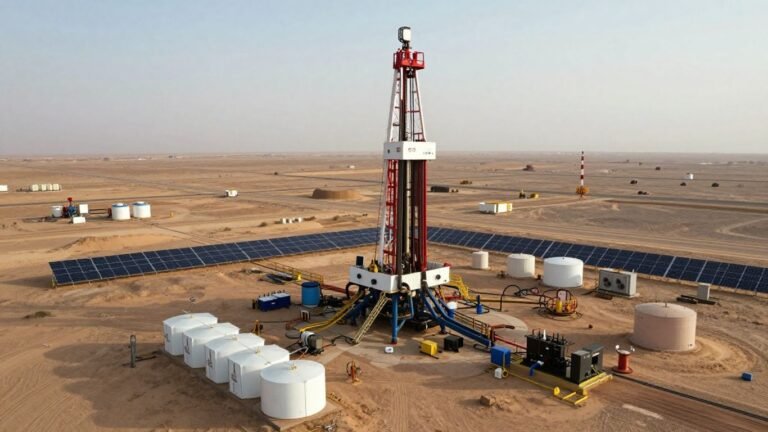
A military base microgrid connects local generation, energy storage, electrical distribution, controls, and loads within a defined boundary. It may operate alongside the utility grid during normal conditions and separate from it when necessary. The goal is not simply to produce electricity on site, but to manage power deliberately around mission requirements. For a useful overview of how localized systems support critical facilities, see this guide to continuous power for critical facilities.
Core components of a base microgrid
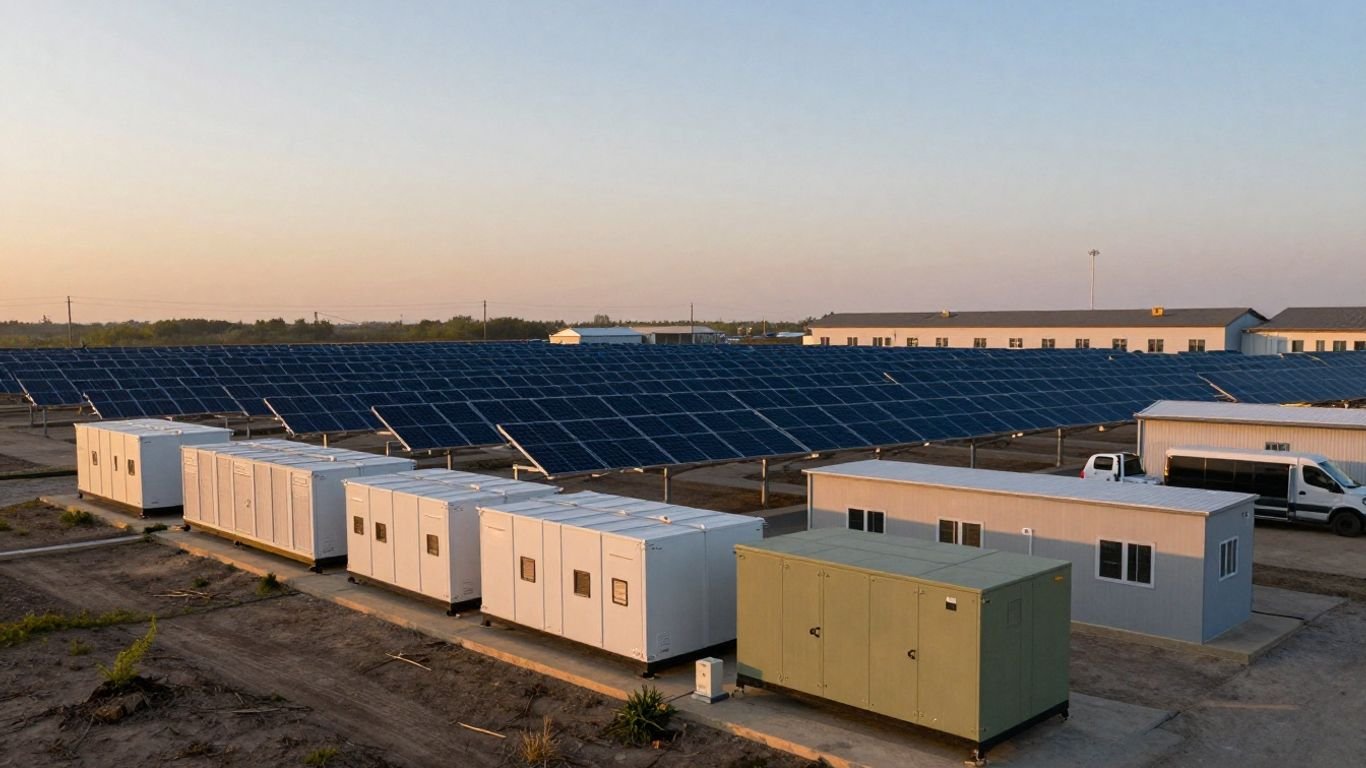
The physical foundation usually includes an electrical distribution network, switches, protective devices, generation, storage, and a controller. Solar arrays and wind turbines can add local production, while batteries provide fast-responding energy and generators supply longer-duration power. Metering and communications help operators understand what is happening across the system.
The exact mix depends on the installation. A base with large aviation loads will have different requirements from one dominated by offices, housing, laboratories, or communications facilities. The design must account for both the electrical characteristics of each asset and the practical conditions under which personnel will operate it.
How microgrids operate with or without the utility grid
In grid-connected mode, the microgrid can draw electricity from the utility and coordinate on-site assets around demand, cost, and readiness. During a disturbance, a point of common coupling can open, separating the installation from the larger network. The local controller then balances generation, storage, and demand inside the islanded system.
Returning to grid-connected operation also requires care. Voltage, frequency, protection settings, and system stability must be checked before reconnection. A microgrid that can isolate cleanly but cannot reconnect predictably is incomplete from an operational perspective.
The connection between energy security and mission readiness
Energy security means having dependable access to the power needed for assigned functions, not merely having a large nameplate capacity. A short interruption can affect communications, security systems, fuel handling, water services, medical support, or command operations. A military base microgrid gives planners another way to separate those mission risks from failures beyond the installation boundary.
That connection makes resilience a planning discipline. Operators need to know which loads must remain energized, how long they must run, which assets can start without the grid, and what procedures apply if automatic controls are unavailable. The answers should be tied to real mission consequences rather than broad assumptions about importance.
How military microgrids differ from commercial systems
Commercial microgrids often focus on business continuity, utility costs, or sustainability targets. Military systems may face stricter requirements for mission continuity, physical security, classified or sensitive operations, and operation under unusual threat conditions. They may also need to support dispersed facilities and equipment that cannot be treated like ordinary commercial loads.
The difference is not that every military system uses unique technology. It is that design decisions are judged against operational readiness and failure consequences. Interoperability and maintainability matter because equipment may be upgraded over time, and the people operating it may change.
How microgrids protect bases from power disruptions
A base can lose utility power because of storms, equipment failure, wildfire, flooding, cyber incidents, or damage to nearby infrastructure. A microgrid does not eliminate those hazards, but it can limit how far they travel into the installation. Its value comes from maintaining a controlled electrical boundary and giving operators options when normal service is interrupted.
The most effective design begins with the facilities that cannot wait for repairs. From there, planners can establish the generation, storage, switching, and fuel arrangements needed to keep those loads supplied. The result is a more deliberate response than simply starting a collection of disconnected backup generators.
Islanding during grid outages
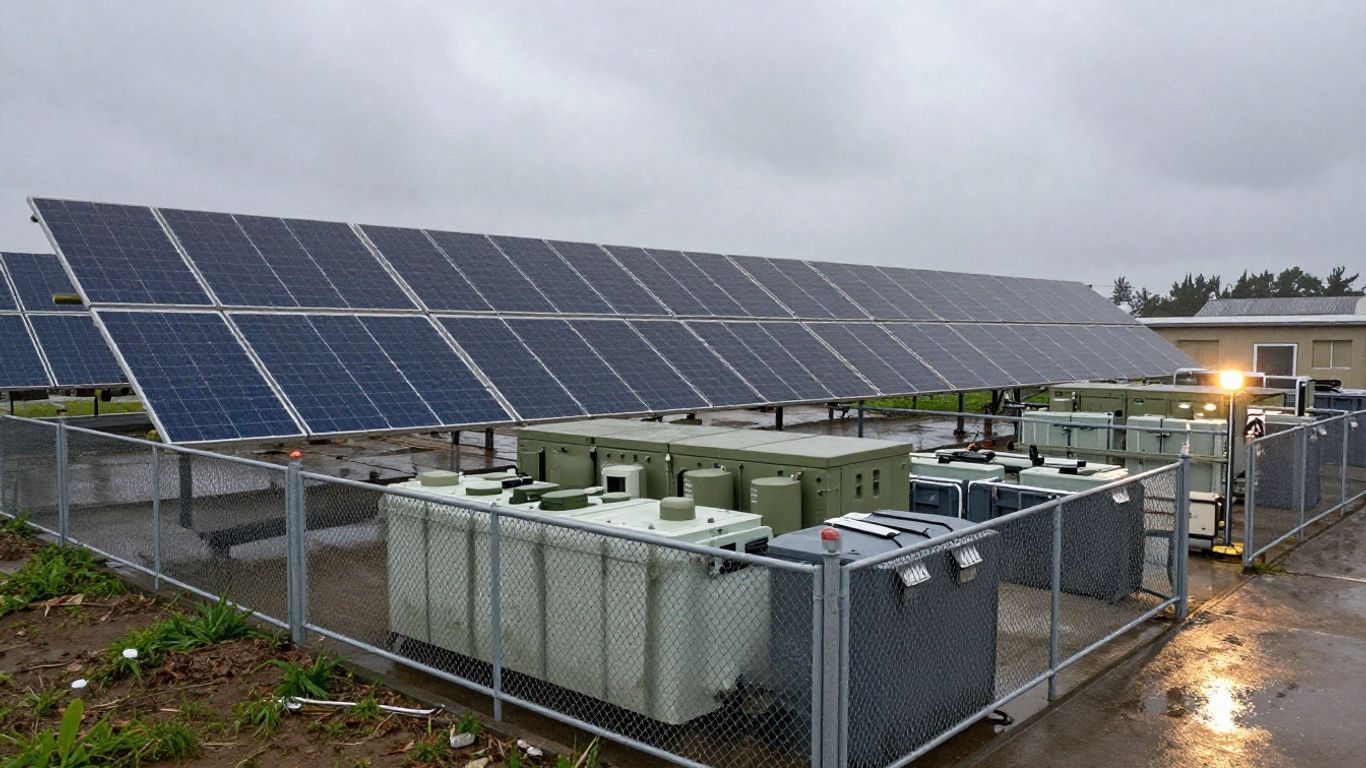
Islanding is the process of separating the microgrid from the utility system while continuing to serve selected local loads. Detection, switching, protection, and control must work together quickly enough to avoid damaging equipment or creating unsafe conditions. The transition may be automatic, manual, or a combination of both, depending on the architecture.
Once islanded, the system must balance supply and demand. Batteries can respond quickly, generators may carry sustained loads, and noncritical demand can be reduced if available capacity falls. Successful islanding therefore depends on both electrical equipment and a clear load hierarchy.
Managing extreme weather and natural disasters
Weather resilience starts before the event. Designers may consider equipment elevation, protected fuel storage, hardened distribution routes, vegetation management, drainage, and access for maintenance crews. The right choices vary by location, but the central question is consistent: which failures are most likely, and how long could recovery take?
Distributed resources can also reduce dependence on a single point of failure. If one feeder or generator is unavailable, other assets may preserve a smaller operational island. That does not make the installation invulnerable; it gives personnel more ways to keep essential services running while repairs proceed.
Reducing exposure to grid failures and physical attacks
A microgrid can reduce reliance on long transmission paths and vulnerable utility assets, especially when local generation and storage are placed near critical loads. Physical separation between assets may further limit the effect of damage in one area. However, distributed equipment also creates more locations that require protection, inspection, and access control.
Resilience planning should therefore include the utility interface, internal feeders, substations, generators, batteries, communications, and control rooms. Treating only the central plant as a security concern leaves important weaknesses elsewhere in the system.
Maintaining power for mission-critical facilities
Critical-load planning identifies the facilities and systems that must remain available during an outage. These may include command functions, emergency services, communications, security, water, medical support, and other installation-specific operations. Each load should have a known operating profile rather than an estimate based only on its building name.
A practical sequence is to classify loads, measure their demand, confirm starting requirements, and test the switching plan. Microgrid resilience for critical facilities follows the same broad principle: local generation, storage, and controls must be considered together rather than as isolated purchases.
How distributed energy resources strengthen resilience
Distributed energy resources give a microgrid several ways to produce, store, and manage electricity. Solar and wind can reduce fuel use when conditions allow, batteries can respond in seconds, and firm generators can support longer periods without utility service. Their value comes from coordination, not from any single technology.
A portfolio also makes tradeoffs visible. Renewable output varies, batteries have finite duration, and generators depend on fuel logistics and maintenance. The system must be sized around the mission and the likely outage, not around an abstract preference for one resource.
Combining solar, wind, and other renewable generation
Renewable generation can provide useful local power during ordinary operation and contribute to islanded service when weather conditions support it. Solar production often follows daylight hours, while wind output depends on local conditions. Multiple sources may reduce the chance that all renewable output falls at once, although they do not remove the need for dispatchable resources.
Interconnection equipment and inverters must be compatible with the microgrid’s operating modes. Operators also need visibility into forecast production so they can plan storage, generator dispatch, and load priorities before a disturbance occurs.
Using battery energy storage for backup power
Batteries can supply power rapidly during a transition, smooth renewable output, and help manage short-duration interruptions. They may also support voltage and frequency control, depending on their inverter and control configuration. Their usable capacity depends on state of charge, temperature, degradation, and the power demanded by connected loads.
For that reason, a battery should not be described simply as a fixed number of backup hours. Planners need to model several operating conditions, including a sudden outage, a prolonged island, a failed generator, and a period of low renewable production. Battery replacement and end-of-life planning belong in the original business case.
Integrating generators and other firm energy sources
Generators remain useful when the installation needs sustained power and renewable output is uncertain. They can support critical loads through a long outage, recharge batteries, or provide a stable reference for other resources. Their usefulness depends on start capability, maintenance, fuel quality, environmental conditions, and the availability of trained operators.
A hybrid arrangement may also include other firm sources where appropriate. The key is to define how each source starts, what it can carry, how it shares load, and what happens if it fails. Redundancy is meaningful only when the remaining equipment can actually support the required operating state.
Balancing reliability, fuel availability, and emissions goals
Resilience decisions involve competing requirements. More fuel on site can extend endurance but increases storage, security, and maintenance obligations. More renewable generation can reduce fuel consumption but may require additional storage and controls. Larger batteries can improve flexibility but add cost, thermal management needs, and replacement considerations.
A balanced design makes these assumptions explicit. It also recognizes that emissions goals and mission assurance can support each other without being treated as identical objectives. The right mix is the one that meets the installation’s required performance under credible scenarios.
How a military base microgrid manages energy demand
Generation is only half of resilience. The other half is knowing where electricity is going and deciding which loads should receive it when supply is constrained. Energy management systems help operators coordinate those decisions across buildings, equipment, storage, and generation.
This is where a microgrid becomes an operating system for power rather than a collection of assets. Measurements, forecasts, priorities, alarms, and procedures must be understandable to the people responsible for keeping the installation running.
Prioritizing critical and noncritical loads
Load prioritization creates an orderly response when available power is limited. Critical loads receive the highest protection, while flexible or nonessential loads may be delayed, reduced, or disconnected. Some loads may move between categories depending on the mission, time of day, or emergency condition.
A useful plan records more than the total demand of each building. It captures starting currents, minimum operating levels, acceptable interruptions, and the consequences of shedding the load. That information supports both system sizing and emergency procedures.
Using intelligent controls and energy management systems
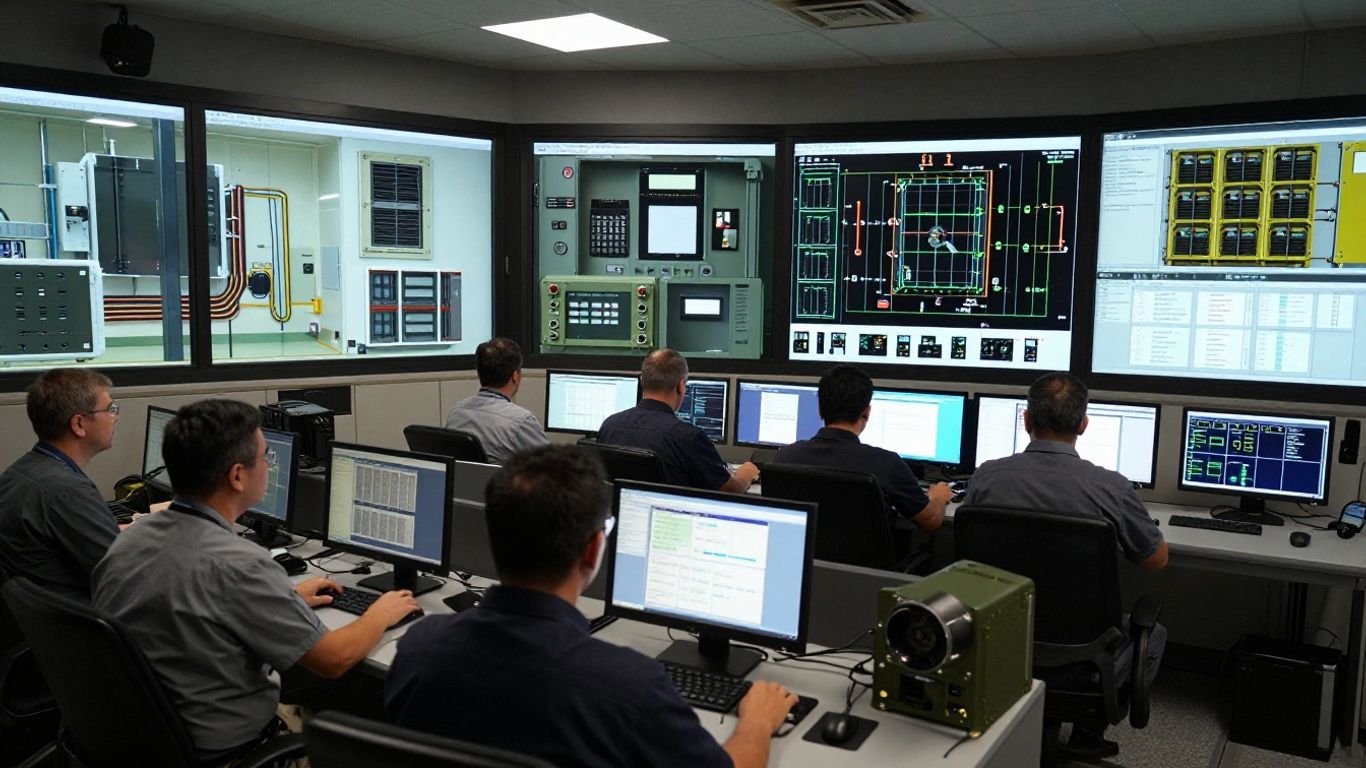
Controls coordinate switches, generation, storage, meters, and loads according to the selected operating mode. They can monitor power flows, dispatch resources, issue alarms, and support transitions between grid-connected and islanded operation. A controller should also present information in a form operators can act on under pressure.
The design should allow for degraded conditions. If communications fail or an automated sequence behaves unexpectedly, personnel need safe manual alternatives. Automation improves consistency, but it should not become the only path to maintaining service.
Improving power quality for sensitive equipment
Sensitive electronics can be affected by voltage variation, frequency changes, harmonics, and brief interruptions. A microgrid may address these concerns through equipment selection, filtering, inverter controls, protection coordination, and careful separation of loads. The required approach depends on the equipment and the quality limits specified by its manufacturer.
This is also why power quality should be measured rather than assumed. A system can have enough megawatts and still cause operational problems if voltage or frequency performance is poor. Monitoring helps reveal disturbances that a simple outage counter would miss.
Coordinating buildings, vehicles, and on-site generation
Buildings can contribute to resilience through flexible heating, cooling, ventilation, and charging schedules. Electric vehicles may become additional loads or, where the equipment and policy allow, sources of stored energy. On-site generation and storage must be scheduled around these changing demands rather than treated as fixed resources.
A simple operating checklist can help teams coordinate those moving parts:
- Confirm the current operating mode and available generation.
- Verify critical-load status and battery state of charge.
- Review fuel supply, alarms, and equipment availability.
- Apply the approved load-shedding or restoration sequence.
The checklist does not replace automated control or engineering analysis. It gives operators a shared starting point when conditions change quickly, which is often just as valuable as another dashboard.
Security, cyber risks, and operational challenges
A microgrid expands the number of devices, networks, interfaces, and procedures that must be protected. Digital controls can improve visibility, but they also create pathways that require careful governance. Physical assets, fuel systems, communications equipment, and operator accounts all belong in the security conversation.
The challenge is to build security into the architecture without making the system too difficult to operate. Controls that cannot be maintained, patched, tested, or understood by personnel may create practical risk even when their design appears sophisticated.
Protecting microgrid controls and communications networks
Controllers, intelligent electronic devices, inverters, meters, and remote-access tools should be protected according to their function and exposure. Segmentation can limit movement between networks, while authentication, least-privilege access, logging, backups, and tested response procedures help reduce the effect of compromise.
Cybersecurity planning should cover both information technology and operational technology. A useful microgrid cybersecurity guide can help teams examine decentralized assets, network segmentation, supply-chain risks, and incident response without treating cybersecurity as an afterthought.
Addressing interoperability across equipment and systems
Equipment from different manufacturers may use different protocols, data models, and control assumptions. Without clear interface requirements, integration can become expensive and fragile. Testing should cover ordinary dispatch, islanding, reconnection, alarms, communications loss, and equipment failure.
Interoperability also affects future upgrades. The Tactical Microgrid Standard is a useful reference point for the broader idea that common control and communication interfaces can help power components work together as a cohesive system. Any installation still needs to verify how its specific equipment behaves.
Securing fuel supplies and distributed assets
Fuel security includes storage capacity, delivery routes, quality testing, replenishment contracts, access controls, and contingency planning. Renewable assets and batteries have different security needs, including fencing, fire protection, environmental monitoring, spare parts, and inspection routines.
Distributed equipment can improve resilience, but it can also be overlooked because no single asset appears indispensable. Asset inventories, maintenance schedules, and clear ownership help prevent small failures from accumulating into a larger operational weakness.
Training personnel to operate and maintain the microgrid
Training should combine classroom instruction with hands-on practice. Operators need to understand normal dispatch, emergency transitions, alarms, manual switching, load shedding, safe isolation, and restoration. Maintenance teams need practical knowledge of controls, protection, batteries, generation, and communications.
Exercises should include imperfect conditions. A realistic drill might involve a utility outage, reduced battery availability, a failed communications link, or a generator that cannot start. These scenarios reveal gaps that a demonstration under ideal conditions will not show.
Planning for faults, failures, and manual operation
Every microgrid has failure modes. Switches can fail, batteries can trip, generators can run out of fuel, sensors can provide bad data, and communications can disappear. A resilient design identifies those conditions and defines safe fallback states before an emergency occurs.
Manual operation should be treated as a designed capability, not an improvised last resort. Procedures, labels, access controls, and regular exercises make it more likely that personnel can stabilize the system while automated functions are restored.
How military bases plan and measure microgrid performance
Planning starts with mission requirements and ends with verified performance. A technically impressive system can still miss its purpose if it is oversized in the wrong places, difficult to maintain, or unable to sustain the loads that matter most. Bases should therefore connect engineering decisions to measurable operational outcomes.
Phased planning can reduce uncertainty. An installation may begin with an assessment and pilot, test controls and procedures, then expand after reviewing actual data. Each phase should preserve a clear path toward the larger resilience objective.
Assessing facilities, loads, and mission requirements
The first assessment should map buildings, feeders, generators, storage sites, utility interfaces, and critical processes. Load data should be collected over time and supplemented with information about starting currents, seasonal variation, growth, and acceptable interruption limits. Interviews with mission owners can reveal dependencies that electrical records miss.
The result should be a ranked set of requirements. Instead of asking only how much power the base uses, planners should ask which services must continue, for how long, under which conditions, and with what recovery sequence.
Selecting the right generation and storage mix
Resource selection follows the requirements assessment. Solar, wind, batteries, generators, and other sources should be compared by usable power, duration, start time, fuel or weather dependence, maintenance burden, footprint, and lifecycle cost. The analysis should test combinations rather than evaluating every technology in isolation.
A system model can show whether storage is intended for ride-through, peak management, renewable shifting, generator support, or extended backup. Those uses may require different power and energy ratings, so the label “battery backup” is not enough to define the design.
Evaluating costs, funding models, and lifecycle value
Capital cost is only one part of the decision. Bases should account for interconnection work, construction, controls, cybersecurity, fuel infrastructure, maintenance, replacement, training, testing, and eventual decommissioning. Funding and contracting structures can change who owns the assets and who carries performance obligations.
Lifecycle value should be compared against the cost of interruption and the value of avoided failures. This does not mean every resilience benefit can be reduced to a precise dollar figure. It does mean that assumptions should be visible, defensible, and reviewed by both technical and mission stakeholders.
Measuring resilience, availability, and recovery time
Performance measures should reflect what the installation needs from the system. Useful indicators may include critical-load coverage, islanding success, time to restore service, duration of autonomous operation, equipment availability, power quality, fuel endurance, and the frequency of manual interventions.
The measures become more useful when tested under realistic conditions. A system that performs well during a short planned exercise may behave differently during a long outage, a hot-weather peak, or a communications failure. Regular testing turns resilience from a promise into evidence.
Scaling a pilot project across the installation
A pilot should answer practical questions about controls, staffing, maintenance, interconnection, cybersecurity, and load priorities. It should produce operating data, not just a commissioning photograph. Lessons learned can then shape technical standards and procurement requirements for later phases.
Expansion works best when the architecture remains modular and interfaces are documented. Each additional feeder or resource should strengthen the operating plan rather than create a separate island of equipment that personnel must manage independently.
Conclusion
A military base microgrid improves energy security by combining local resources, controlled distribution, and mission-focused operating procedures. Its success depends on more than generation capacity: islanding, load priorities, cyber protection, fuel planning, trained personnel, and measured performance all matter. When those pieces are designed together, a base gains a practical way to keep essential operations running through disruptions that would otherwise reach deeply into its mission.
Frequently Asked Questions
What is a military base microgrid?
It is a localized electrical system that coordinates generation, storage, controls, distribution equipment, and connected loads so an installation can operate with the utility grid or separately from it.
Why do military bases use microgrids?
They use microgrids to improve continuity for critical operations, reduce dependence on vulnerable external infrastructure, and manage local energy resources during normal and emergency conditions.
Can a microgrid operate during a utility outage?
Yes. If it is designed and configured for islanded operation, it can disconnect from the utility grid and continue serving selected loads with available local resources.
What energy resources can a base microgrid include?
A system may include solar, wind, battery storage, generators, utility service, and other firm energy sources. The appropriate combination depends on mission requirements, site conditions, and outage scenarios.
How does a microgrid protect critical facilities?
It identifies priority loads, coordinates available supply, and uses switching and control systems to keep those loads energized when broader grid service is interrupted.
What are the main challenges of military microgrids?
Common challenges include cybersecurity, interoperability, fuel logistics, equipment maintenance, training, funding, protection coordination, and operating safely when automated systems or communications fail.
How is microgrid performance measured?
Performance can be measured through critical-load coverage, islanding success, availability, recovery time, autonomous operating duration, power quality, fuel endurance, and results from realistic exercises.